Dear brothers and sisters,
I warmly welcome you on the occasion of your General Assembly, called to reflect on the theme "Assistance to the elderly and palliative care", and I thank the President for his kind words. I am especially pleased to greet Cardinal Sgreccia, who is a pioneer… Thank you.
Palliative care is an expression of the truly human attitude of taking care of one another, especially of those who suffer. It is a testimony that the human person is always precious, even if marked by illness and old age. Indeed the person, under any circumstances, is an asset to him/herself and to others and is loved by God. This is why when their life becomes very fragile and the end of the their earthly existence approaches, we fell the responsibility to assist and accompany them in the best way
Address oh His Holiness Pope Francis to Participants in The XXI General Assembly of The Pontifical Academy for Life.
"Virtues in Ethics of Life" is the theme of the workshop organized by the Pontifical Academy for Life, which will be held on March 4th, in the New Synod Hall, on the occasion of the 22nd Plenary Assembly of the Members of the Pontifical Academy for Life.
The work of the first session, entitled "The dynamics and completion of the moral act in the virtues" (moderated by Msgr. Fernando Chomali and Prof. Mónica López Barahona), will be opened by Alfredo Cruz Prados, University of Navarra (Spain), with a lecture on "Knowledge and the experience of the good: analogy, differences and the synergy between speculative and practical reason." This session will then continue with lectures by Angel Rodgriguez Luno, Pontifical University of the Holy Cross, on "The intentionality of the human act: good and evil from a moral perspective;" Antonio Da Re, University of Padua, on "Virtue ethics and moral life;" and Luciano Sandrin, Camillianum (Rome), on "Mercy and compassion."
During the second session, entitled "Biomedical ethics from a virtues perspective" (moderated by John Haas [USA] and Mounir Farag [Egypt]), Jeffrey Bishop, Saint Louis University (USA), will give a lecture on "Medical decision-making and the problems of 'Proceduralist bioethics';" Maureen Condic, University of Utah (USA), will speak on "Virtues beyond the utilitarian approach in biomedical research" and Reiko Joh, of the Association of Catholic Nurses of Japan (Japan), will discuss "Ethical virtues in the nursing profession."
During the third session: "The rediscovery of the virtues" (moderated by Adriano Pessina and Laura Palazzani [Italy]), the speakers will be Roberto Dell'Oro, Loyola Marymount University (USA), on "Professionalism and virtues;" Gabriella Gambino, University of Tor Vergata, on "Care and justice;" Antonio Amado Fernandez, University de Los Andes (Chile), on "Educating in virtue within the biomedical discipline." "The virtuous institution in service to life" will be discussed by Mounir Farag, of the St. Joseph Institute for the Family pro Vita and Bioethics/OMS (Egypt); Andrew Pinsent, Oxford University (UK) will speak on "Current research trends in virtue ethics;" Adam Rybicki, Catholic University of Lublin (Poland), will speak about "The defense of life between parresia, mercy and forgiveness;" and Eberhard Schockenhoff, University of Freiburg (Germany), will give a lecture on "The Christian perspective on the virtues."
A new season in bioethical reflections is at hand. We are witnessing extraordinary developments in life sciences and in the new "converging technologies" (genetics, information technology, nanotechnologies and neurosciences), which open up unprecedented possibilities for interventions on living matter. The human body is exposed to practices that risk reducing it to the status of any neutral biological subject, as if it were an entity independent of the person rather than its basis in space and in history. This approach, veined with Gnostic contempt, risks obfuscating the symbolic scope of the body and its essential role in the advancement of a meaningful world.
On the other hand, globalization is profoundly transforming the context in which bioethical questions are posed.
Cultures find themselves coexisting in closer relations as a direct result of the growth in the movement of peoples and the intensification in communications. There is a growing public awareness that environmental phenomena and peoples' lives are increasingly interconnected. There is also a better understanding that inequalities and imbalances in the conditions of life in society and in the different parts of the planet are not due to random factors, but are the effects of choices that neglect justice and the legitimate needs of all the Earth’s populations, present and future.
There are many examples of problems related to clinical practice and biomedical research in which these interconnections are apparent. To cite only some which have the most immediate bioethical impact: the definition and compliance with the rules of scientific research that are the same for everyone and equally respectful of the dignity and rights of people; the principle of the prohibition of the commercial exploitation of the human body or its parts on the international market; the prohibition of interventions on the genome that introduce modifications destined to be inherited by descendants; the fight against the threat of bio-terrorism.
The classical topics of bioethics have therefore taken on a far wider scope. Then again, the number of themes dealt with has also expanded: food safety, inequalities in access to care and in the distribution of the results of scientific research, environmental factors on health.
"Technology that puts itself at the service of the care for life, refusing to discard it when it does not meet standards of efficiency and wellbeing decided by a machine, is a real blessing. When technology takes power, with our passive complicity, we ourselves become responsible for the loss of that blessing. We must be lords of technology, at the service of life; and not masters of life, subject to technology. This is the covenant that we must seal. The complexity of this discernment is certainly real. It requires a period of careful and open listening and critical understanding of the phenomena that surround us. The tools that we have are,
all in all, not very sophisticated or dependable. Scientific research is an irreplaceable part of this covenant. The hidden pitfall in new technological resources is the great extent of their invisibility. They cannot be perceived physically or mentally by individuals or by the community. They are not large and impressive machines. They are virtual relationships and the results of calculations. Even before they establish connections between humans, these devices connect with each other.
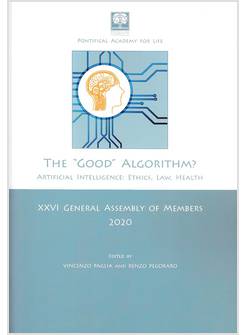
Artificial intelligences, algorithms that can learn, so-called machine learning, and other cognitive computer systems are the vehicles of this revolution. These systems are spreading more and more to every area of our life as in the past steam and electricity changed the way we carried out all our activities. For this reason, closely connected with this meeting, artificial intelligence will be the theme of next year’s workshop. We want to approach this new frontier forcefully and passionately, with as much wide cooperation as possible. To honor, with science and conscience, the task that has been authoritatively entrusted to us".
(From the Opening Address, by Archbishop Vincenzo Paglia)
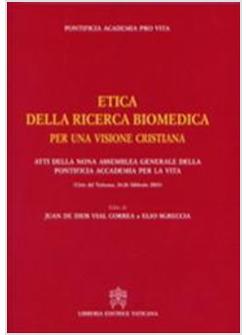
Il volume raccoglie gli Atti della nona Assemblea Generale della Pontificia Accademia per la Vita (Citta del Vaticano, 24-26 febbraio 2003) sul tema dell'etica cristiana della ricerca biomedica. L'etica della ricerca riguarda anzitutto il processo che l'investigazione programmata richiede: il progetto nelle sue finalita e nei finanziamenti; l'etica della sperimentazione; la fase applicativa di ordine tecnologico o clinico; la questione dell'assegnazione delle risorse economiche e la giustificazione degli eventuali brevetti; la messa a disposizione dei farmaci o dei presidi terapeutici. La stessa sperimentazione animale non e scevra di problemi etici, mentre le questioni piu delicate toccano non solo il processo della ricerca come tale ma l'oggetto-soggetto della sperimentazione: l'embrione, il feto, la donna, i problemi emergenti dalla procreazione assistita, dalla clonazione, dall'uso delle cellule staminali.
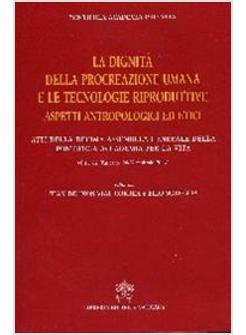
Atti della X Assemblea Generale della Pontificia Accademia Per la Vita (Vaticano, 20-22 febbraio 2004). Il tema affontato e piu che mai attuale dato che tratta della procreazione artificiale. Spesso la letteratura scientifica sulla procreazione artificiale considera i risultati e gli effetti di tale tecnologia in maniera parziale, limitandosi all'osservazione dei dati clinici ed epidemiologici, solo raramente prendendendo in conto gli aspetti psicologici. L'etica viene ridotta all'etica utilitaristica e in termini di percentuale. L'aspetto che la Pontificia Accademia per la Vita ha voluto considerare e quello antropologico nel suo significato profondo, spirituale e morale, per vedere quale concezione dell'uomo, del genere umano, della genitorialita, della relazione parentale si configurano quando si realizza tecnologicamente la separazione del momento procreativo dall'atto coniugale, per rimettere l'inizio della vita al tecnologo e alla strumentazione.
Sono esposti i dati piu recenti offerti dalla scienza sulle cellule staminali e dalla tecnologia sulla loro produzione e uso. Nella seconda parte l'attenzione e richiamata sopra i problemi etici piu rilevanti sollevati da queste scoperte e applicazioni. La finalita di questo documento e`di portare un contributo al dibattito che si sta sviluppando e ampliando nella letteratura scientifica ed etica e nell'opinione pubblica sulla pr oduzione e utilizzazione delle cellule staminali embrionali. A seguito, infatti, della crescente rilevanza che va assumendo il dibattito sui loro limiti e liceita, si impone una riflessione che ne ponga in luce le implicazioni etiche. In una prima parte, saranno esposti molto brevemente i dati piu`recenti offerti dalla scienza sulle cellule staminali, e dalla biotecnologia sulla loro produzione e uso. I n una seconda parte, si richiamera l'attenzione sopra i piu` rilevanti problemi etici sollevati da queste nuove scoperte
Il volume si propone di fornire al lettore un'ampia panoramica delle questioni di bio diritto, una disciplina, recentemente emersa, in cui si intersecano profili scientifici, giuridici e morali, avente per oggetto lo studio (e la critica) dei modi in cui il diritto disciplina (o non disciplina) le questioni di bioetica. In particolare, i saggi qui raccolti vertono su alcuni dei temi oggi più discussi, in un percorso ideale che va dall'inizio della vita (con le questioni legate, ad esempio, alla fecondazione artificiale) alla sua fine (affrontando problemi quali quelli relativi all'eutanasia o alla definizione di morte).
Da duemila anni a questa parte il celibato è una scelta di vita fatta propria sia da uomini che da donne, dentro la Chiesa cattolica. E oggi è anche - giustamente - al centro delle controversie sulla condizione dei preti cattolici, dei religiosi e delle religiose, dei laici e delle laiche consacrati. In una società ipersessualizzata, nel momento in cui scoppiano scandali che hanno il clero per protagonista, il celibato viene sempre più guardato con forte sospetto, o perlomeno come una bizzarria. Per questo è importante demistificare tanti luoghi comuni, spiegarlo e gettare nuova luce sul suo significato. Questo libro, che rifiuta qualsiasi idealizzazione del celibato, tiene conto delle esperienze personali concrete fatte dall'autrice e dei progressi delle scienze umane. Per dimostrare che, sebbene il celibato non sia affatto privo di insidie, esso un senso ce l'ha agli occhi dell'umanità comune, delle nostre vite aggrovigliate. E, esattamente come la vita di coppia, mette l'amore alla prova della realtà.
Cosa genera la sofferenza in un bambino, un ragazzo o un adolescente? Come stare loro accanto nella dura stagione della malattia? È possibile affrontare la morte, con parole di speranza? Finalmente un percorso che osa toccare con mano le dolorose esperienze del limite, ascoltando le emozioni che nascono nei ragazzi, senza pessimismo. Nemmeno a Dio piace la sofferenza. Gesù sapeva piangere e arrabbiarsi, si prendeva cura dei malati e ha resuscitato Lazzaro. Egli stesso è passato attraverso la sofferenza e la morte, vincendola con la Resurrezione. E con questa promessa di Vita per tutti e la certezza che la croce è solo "collocazione provvisoria" che nasce questo libro.